
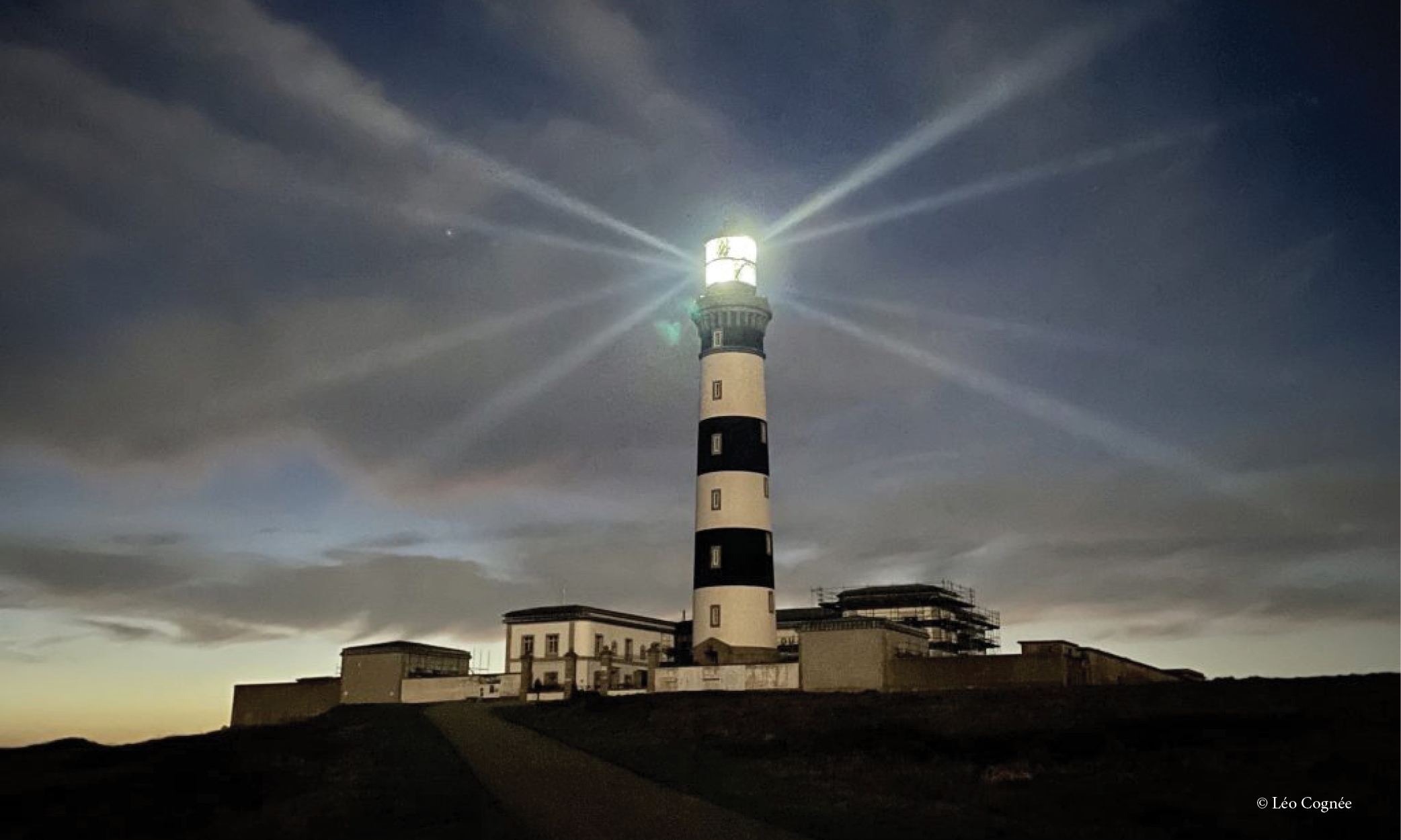
At the westernmost edge of France, in the powerful waters of the Atlantic, the island of Ouessant stands as a final watchtower before the vastness of the ocean. This wild and majestic land embodies the strength of the bond between humankind and the sea, as well as a unique technical history. With its exceptional concentration of lighthouses, seamarks, sound signals and modern aids to navigation, Ouessant is one of the most emblematic territories in the history of French maritime signalling. The Créac’h lighthouse, La Jument, Kéréon, Nividic and the Stiff lighthouse together form a rare heritage and technical ensemble, where maritime innovation has developed in direct response to some of the most demanding conditions.
Located at the western entrance to the English Channel, where the Atlantic meets one of Europe’s major shipping routes, Ouessant occupies a strategic position for maritime safety. The surrounding waters are marked by strong currents, often challenging weather conditions and a high density of traffic. The Ushant Traffic Separation Scheme, designed to organise and secure navigation in this sensitive area, sees around 150 vessels transit each day, depending on the period and the counting perimeter used.
This situation creates a permanent need for buoyage, marking and maritime safety systems. As early as the 19th century, the waters around Ouessant became a major area for French maritime signalling. The light, sound and later radioelectric systems deployed there reflect a constant search for reliability in an environment where signal accuracy can be decisive.
Before the widespread deployment of modern lighthouses, sailors relied on natural or built landmarks, known as seamarks, to orient themselves. On Ouessant, several such seamarks were used for navigation. The Runiou pyramid, located at the Pointe de Porz Doun, was notably used for visual alignments with the church bell tower and the white-painted rock at the Pointe de Pern.
The construction of the Stiff lighthouse at the end of the 17th century marked a major milestone. After visiting the island in 1685, Vauban proposed the construction of a tower intended to signal the dangers lying to the north-west of Brest. The Stiff tower was finally built in 1699. Still in operation today, it remains one of the oldest working lighthouses in France. It guides vessels arriving from the open sea, from northern Finistère, or heading towards Ouessant.
With the growth of maritime trade, the waters around Ouessant became a strategic area for securing access to the English Channel. The modern traffic separation scheme, known as the Ushant Traffic Separation Scheme, would later extend this safety logic to international shipping. Yet as early as the 19th century, the construction of the Créac’h lighthouse already illustrated the growing importance of maritime signalling.
Commissioned in 1863, the Créac’h lighthouse, together with Bishop Rock Lighthouse in England, marks the entrance to the English Channel for vessels arriving from the Atlantic. Its white light, with two grouped flashes every ten seconds, has a nominal range today of 30 nautical miles, or approximately 55.6 km. It was long one of the most powerful lighthouses in the world and remains one of the great symbols of lighthouse engineering.
The exceptional reach of the Créac’h lighthouse is based on a monumental optical system built on the principles of Fresnel lenses. Its current system comprises four lenses, each made up of two 2/9 panels, with a focal length of 0.65 metres. Their two-tier arrangement is unique. The lighting is currently provided by four high-power metal-halide halogen lamps of 2,000 watts.
The lantern of the Créac’h lighthouse, presented at the Paris World’s Fair in 1937, was installed on the lighthouse in the late 1930s. It helped make the Créac’h the most powerful lighthouse in the world at the time. The building has been listed as a historic monument since 23 May 2011.
This monumental optical system, weighing 17 tonnes, still rests on a bath of 85 litres of mercury. Remarkable from a technical standpoint, this system now raises health and environmental concerns. The French State has launched a gradual process to remove mercury from French maritime lighthouses by 2030, while seeking a solution for the Créac’h that preserves both maritime safety and the heritage identity of its distinctive light signature.
In the frequent fogs surrounding Ouessant, sound signals long played an essential role. At the Créac’h, a compressed-air sound trumpet was installed at the Pointe de Pern to complement the light signal when it was obscured by fog. Various sound systems then succeeded one another as technology evolved.
The memory of these devices is still visible on the island. At the Pointe de Pern, the municipality of Ouessant mentions the remains of an old steam-powered foghorn that operated between 1885 and 1900. Other equipment, such as submarine bells and radio beacons, also contributed to this history of sound and radioelectric signalling. These devices gradually lost their central role with the development of radio beacons, radiogoniometry, and then modern surveillance and navigation systems.
The 20th century marked a spectacular advance in the conquest of the most hostile zones along the Ouessant coastline. The construction of offshore lighthouses on isolated reefs demonstrates a high level of maritime expertise, combining robustness, innovation and adaptation to extreme environmental constraints. Three emblematic achievements illustrate this period: La Jument, Kéréon and Nividic.
La Jument lighthouse is located off the south-western approaches to Ouessant, at the south-western end of the Fromveur passage, on the rock known as La Jument. This particularly dangerous site was selected in the early 20th century as one of the major offshore construction projects within the marking system for the approaches to Ouessant. The light was first lit on 15 October 1911.
The structure reaches a height of 47.40 metres. Its current light is a red light produced by a 3 x 12-watt LED lantern, with three grouped flashes every 12 seconds and a range of 10 nautical miles. The lighthouse has been automated since 1991. In 2015, the mercury bath was removed and an LED light was installed. In 2023, the lighthouse was solar-powered through the installation of solar panels, while retaining a backup generator.
La Jument also entered popular culture thanks to the famous photograph taken by Jean Guichard on 21 December 1989, showing the lighthouse struck by a gigantic wave while the keeper appears in the doorway. This image helped make La Jument one of the most powerful symbols of lighthouse keepers’ lives in the face of the sea.
Located south-east of Ouessant, in the Fromveur passage, north-west of Bannec Island, Kéréon lighthouse stands on the Men-Tensel rock. It was designed to secure night navigation in one of the most feared sectors of the Iroise Sea.
Rising to a height of 47.25 metres, Kéréon is also one of the most luxuriously appointed offshore lighthouses. Its staircase, mosaics, Hungarian oak panelling and floor decorated with a compass rose in ebony and mahogany give it a unique place in French maritime heritage. The DIRM describes it as the last “monument lighthouse” built at sea.
Its current light displays 2+1 occultations, with a white sector range of 17 nautical miles and a red sector range of 14 nautical miles. It operates with a 35-watt LED lamp and a fixed cut-glass optic with a focal length of 0.92 metres. Since 29 January 2004, Kéréon lighthouse has been fully automated and remotely monitored.
Nividic lighthouse, located at the far end of the Pointe de Pern, is one of the most innovative achievements in the history of French lighthouses. Built on the Men Garo reef, which is extremely difficult to access by sea, it was designed from the outset as an automatic offshore lighthouse, with no resident keeper.
Foundation work was carried out from 1912 to 1915. Construction of the tower began in 1916 and was completed in 1930. An overhead cable was then installed from the Pointe de Pern to supply the energy required for the light, the sound signal and the automation controls. Two intermediate reinforced concrete pylons served as relays between the shore and the lighthouse.
This system also enabled maintenance personnel to be transported by cable car. The original installation included an electric light, a compressed-air siren powered by electro-compressors, and an acetylene cannon as a backup. First lit in 1936, Nividic is described by the DIRM as the first automatic offshore lighthouse and as a remarkable technical achievement for its time. Since 1996, its light has been equipped with solar panels and it no longer carries a fog signal.
The life of lighthouse keepers was marked by isolation, technical discipline and constant exposure to the elements. On Ouessant, offshore lighthouses required permanent vigilance: monitoring the light, maintaining the optics, checking the machinery and carrying out difficult relief operations in bad weather. Families and island communities also played a part in this history, whose memory is preserved today by the Musée des Phares et Balises.
Installed in the former power station of the Créac’h lighthouse, the museum traces the evolution of aids to navigation and preserves an exceptional heritage linked to lighthouses, optics, lights and maritime signalling devices.
From the late 20th century onwards, the lighthouses of Ouessant were gradually automated, remotely monitored and integrated into a centralised supervision system. The Créac’h now plays a key role in this system: eight agents are responsible for its maintenance and for monitoring the remote control of all maritime signalling establishments in Finistère, with a 24-hour watch.
Modernisation does not take a single form. Some offshore lights have been equipped with LED solutions and autonomous power systems, particularly solar power. La Jument has thus received an LED light and was solar-powered in 2023. Nividic has been operating with solar panels since 1996. The Créac’h, by contrast, retains a historic optical system powered by four high-power metal-halide halogen lamps, whose rotation still relies on a bath of mercury.
This transition illustrates the contemporary challenge of maritime signalling: modernising equipment, reducing environmental risks, optimising maintenance and preserving the heritage value of major historic lighthouses.
Modern maritime signalling no longer relies solely on visible lights or sound signals. It is now part of a broader surveillance and information ecosystem that includes radars, AIS, remote monitoring and maritime traffic systems.
Off Ouessant, monitoring of the traffic separation scheme is carried out by CROSS Corsen, which provides vessel traffic services within a circular area of 40 nautical miles around the island. It monitors the Ushant Traffic Separation Scheme, receives and processes mandatory ship reports, provides safety information and intervenes in the event of a collision risk.
Aids to navigation can also be enhanced by AIS AtoN devices. These systems can improve the identification of an aid to navigation, transmit its position to vessels’ electronic equipment, verify its integrity or report if it has moved off station. It is therefore appropriate to refer here to AIS AtoN, rather than AIS Class B+, the latter being associated with AIS equipment used by certain vessels and not with maritime buoyage or signalling.
These systems are aligned with IALA recommendations and with the French nautical and technical framework applicable to maritime buoyage and signalling. In digital form, they extend the historic mission of lighthouses: to make danger visible, identifiable and understandable for navigators.
Today, Ouessant remains a reference territory for understanding the evolution of aids to navigation. From traditional seamarks to monumental optics, from foghorns to radio beacons, from offshore lighthouses to AIS AtoN systems, the island brings together several centuries of maritime technical history.
For Gisman, Ouessant is a case study in its own right: designed for extreme conditions, maritime signalling there has always had to meet an absolute requirement for robustness, visibility, reliability and continuity of service. The history of the island reminds us that every aid to navigation, whether visual, luminous, sound-based, radioelectric or connected, serves the same mission: to make the sea safer and guide navigators through the most demanding environments.
Ouessant embodies French maritime excellence. From the Runiou pyramid to the Stiff lighthouse, from the Créac’h to La Jument, from Kéréon to Nividic, the island tells the full story of maritime signalling: first visual, then luminous, sound-based, radioelectric and now connected.
A sentinel of the Atlantic and the western gateway to the English Channel, Ouessant remains a living symbol of humankind’s adaptation to the challenges of the sea. Its heritage reminds us that maritime innovation is never abstract: it is born from reality, from currents, fog, reefs, shipwrecks avoided and the permanent need to guide vessels with precision.
← Back to blog